MEMBER OF

7-Day Mount Kilimanjaro Climb Via Machame Route
Mount Kilimanjaro National Park, Gilman's Point, Tanzania
0/5
0% of guests recommend
Duration
7 Days
Tour Type
Mountain & Adventure
Group Size
50 persons
Location
Kilimanjaro
Overview
TOUR OVERVIEW
The 7-Day Machame Route, also known as the "Whiskey Route," is one of the mountain's most popular and scenic routes. The Machame Route offers longer trekking days with steeper ascents, making it a more challenging option. This route is ideal for adventurous climbers with some hiking or backpacking experience and those who are physically fit. The Machame route approaches the summit from the southwest and descends using the Mweka route. The 7-day Machame route trek allows for better acclimatization, which increases your chances of successfully summiting. The Machame Route is known for its high success rate. It is perfect for trekkers who want a challenging, rewarding, and visually stunning climb while experiencing a variety of terrains on their way to the summit.
The 7-day Machame Route is a fantastic choice for climbers looking for better acclimatization, a more relaxed pace, and a higher chance of summit success. The extra day helps climbers adjust to the altitude, recover between days, and enjoy the journey more comfortably, ultimately enhancing the overall climbing experience.
A DETAILED ITINERARY FOR THE KILIMANJARO CLIMB - 7-DAY MACHAME ROUTE
Arrive in Tanzania
You will be picked up at the Kilimanjaro International Airport and transferred to your hotel in Moshi town. There, you will meet our guide, who will brief you on your upcoming trek and check your equipment to ensure you have all the necessary mountain gear ready to begin your Kilimanjaro climb via the 7-day Machame route. Gear that is missing can be rented on this day.
Day 1: Machame Gate to Machame Camp
-Elevation: 1640m to 1835m
-Distance: 11 km
-Hiking Time: 5-7 hours
-Habitat: Rain Forest.
The drive from Moshi to Mount Kilimanjaro National Park Gate takes about 50 minutes. The journey passes through the village of Machame, located on the mountain's lower slopes. We now leave the park gate and walk through the rainforest on a winding trail up a ridge. Lower down, the trail can be muddy and slippery, so gaiters and trekking poles are a good idea here. We continue a short distance until we reach the Machame Camp.
Day 2: Machame Camp to Shira Camp
-Elevation 1835m to 3850m
-Distance: 5 km -Hiking Time: 4-6 hours
-Habitat: Moorland.
After breakfast, we leave the rainforest glades and continue an ascending path, crossing the little valley and walking along a steep rocky ridge covered with heather until the ridge ends. The route now turns west onto a river gorge. It is time for rest, dinner, and overnight at the Shira campsite.
Day 3: Shira Camp to Lava Tower to Barranco Camp
-Elevation 3850m to 460m to 3900m
-Distance: 10 km
-Hiking Time: 6-8 hours
-Habitat: Semi Desert.
From the Shira Plateau, we continue to the east up a ridge, passing the junction towards the peak of Kibo. As we continue, our direction changes to the southeast towards the Lava Tower, called the Sharks Tooth. Shortly after the tower, we come to the second junction, which brings us up to the Arrow Glacier at an altitude of 16,000ft. We now continue down to the Barranco Hut at an altitude of 13,000ft. Here, we rest, enjoy dinner, and overnight. Although you end the day at the same elevation as when you started, this day is very important for acclimatization and will help your body prepare for summit day.
Day 4: Barranco Camp to Karanga Camp
-Elevation 3900m to 3960m
-Distance: 5 km -Hiking Time: 4-5 hours
-Habitat: Alpine Desert
After breakfast, we leave Barranco and continue on a steep ridge, passing the Barranco Wall, to the Karanga Valley campsite. This is a short day meant for acclimatization.
Day 5: Karanga Camp to Barafu Camp
-Elevation 3960m to 4680m
-Distance: 4 km
-Hiking Time: 4-5 hours
-Habitat: Alpine Desert.
After breakfast, we leave Karanga and hit the junction that connects with the Mweka Trail. We continue up to the Barafu Hut. At this point, you have completed the South Circuit, which offers views of the summit from many angles. Here, we make camp, rest, enjoy dinner, and prepare for the summit day. The two peaks of Mawenzi and Kibo can be seen from this position.
Day 6: Barafu Camp to Uhuru Peak to Mweka Camp
-Elevation: 4680m to 5895m to 3100 m
-Distance: 5 km ascent / 12 km descent
-Hiking Time: 7-8 hours ascent / 4-6 hours descent
-Habitat: Arctic
Very early in the morning, between midnight and 2 AM, we will continue our ascent to the summit, which is located between the Rebmann and Ratzel glaciers. You will head northwest, climbing through heavy scree toward Stella Point on the crater rim. This section of the trek is the most mentally and physically challenging.
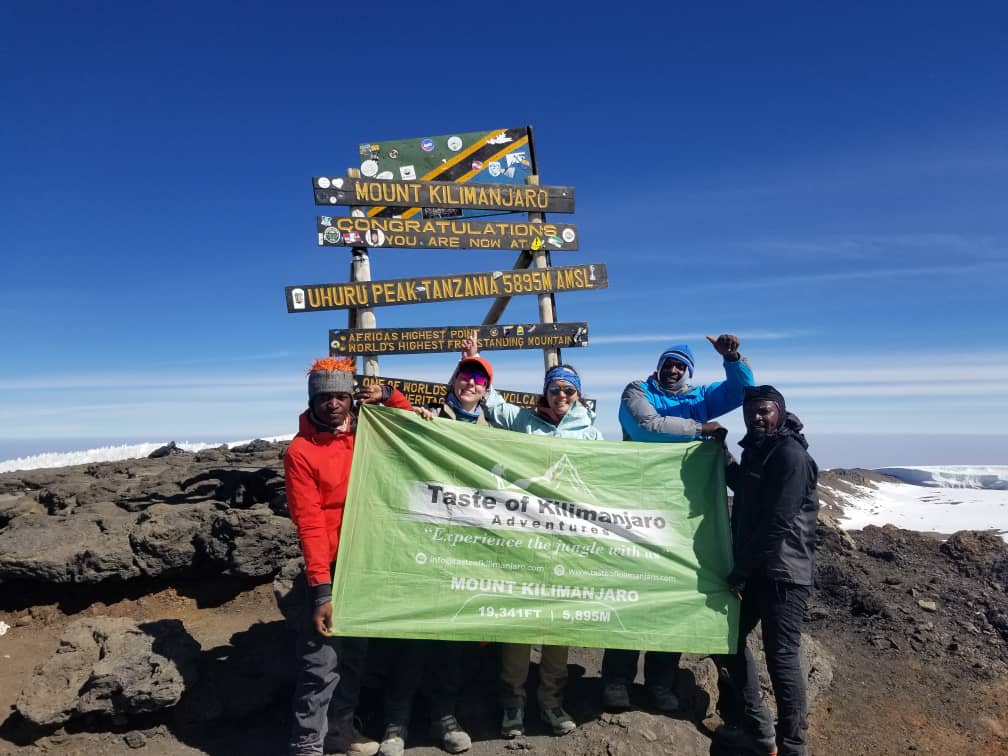
At Stella Point (18,600 ft), we will take a short break and be rewarded with one of the most magnificent sunrises you will likely see, weather permitting. You may encounter snow from Stella Point during the 1-hour ascent to the summit. Upon reaching Uhuru Peak, you will have arrived at the highest point on Mount Kilimanjaro and the entire continent of Africa. Faster hikers may catch the sunrise from the summit.
After enjoying the views at the summit, we will begin our descent, heading straight down to the Mweka Hut campsite and stopping at Barafu for lunch. Using gaiters and trekking poles is advisable due to the loose gravel on the way down. Mweka Camp is in the upper forest, where mist or rain can be expected in the late afternoon. We will enjoy our last dinner on the mountain in the evening and a well-deserved rest.
Day 7: Mweka Camp to Mweka Gate to Moshi
-Elevation: 3100m to 1640m
-Distance: 10 km
-Hiking Time: 3-4 hours
-Habitat: Rain Forest
After breakfast, we will descend to the Mweka Park Gate to receive your summit certificates. At lower elevations, it can be wet and muddy. Gaiters and trekking poles will help. Shorts and T-shirts will probably be plenty to wear (keep rain gear and warmer clothing handy). From the gate, you continue another hour to Mweka Village. This marks the end of your 7-day Kilimanjaro trek via the Machame route. A vehicle will meet you at Mweka village to drive you back to the hotel in Moshi.
Depart Tanzania
The day is free to wind down after the trek before your flight home. Depending on flight times, you could explore Moshi town and grab some souvenirs before heading to the airport.
*Safari, Zanzibar, and other add-ons are available to continue exploring Tanzania.
Included/Excluded
Two nights’ accommodation in Moshi Town (Before & after the trek – B&B)
Airport pick up and drop off.
Qualified guides with mountain crew
Kilimanjaro National Park fees
All camping equipment: mountain tents, sleeping mats
Transport
Rescue fees
All meals on the mountain (breakfast, lunch, and dinner)
Guides and porters’ accommodations and their entry fees on the mountain
Pulse oximeter
First aid kit
Emergence oxygen
Katady filtered water through the trek
wages to guides and porters as approved by Kilimanjaro National Park Authority.
Flights – Domestic and international flights
Visa
Insurance
Tips to mountain crew
Personal Items
Personal Items
Laundry services (available at the hotel for an extra cost)
Travel Styles
Nature & Adventure
FAQs
Which Kilimanjaro route is best?
Lemosho is considered the most beautiful route on Kilimanjaro and grants panoramic vistas on various sides of the mountain. It is the most favorite route because it offers a great balance of low traffic, scenic views, and a high summit success rate. Thus, the Lemosho comes highly recommended and is one of our client’s favorites.
Can I climb Kilimanjaro?
Sure, you can! Climbing Kilimanjaro does not require any technical skills or special equipment, just some physical fitness and determination, people from all walks of life can achieve a successful summited. Individuals from 7 to 89 years old have made it to the top. But the challenge should not be taken lightly. You do need to understand what lies ahead. Rest assured, you will find the answers to all your questions here.
How to avoid altitude sickness at the mountain?
Altitude sickness, also called Acute Mountain Sickness (AMS), is an illness caused by exposure to low air pressure; especially low partial pressure of oxygen, which many climbers experience at high altitudes.
There are several practical steps that you can take to minimize the chances of having to abandon your climb of Kilimanjaro due to the effects of altitude sickness:
• Acclimatize before the climb - This is easier said than done if you live at sea level but if you can spend time at high altitude before the actual Kilimanjaro climb then this is the very best way to avoid altitude sickness.
Starting the climb in the best possible health and with an excellent level of physical fitness is imperative. If you are fatigued, unwell, or stressed you are more likely to suffer from altitude seconds.
• Slow and steady - You need to keep your respiration rate low during the climb you should be able to maintain a normal conversation. If you are panting or breathing hard, you must slow down. Overworking your heart and lungs substantially increases your chance of becoming ill.
• Ascend slowly - Your guides will tell you “polepole polepole (slowly slowly) throughout your climb. Because it takes time to acclimatize, your ascension should be slow. You will make slow and steady progress each day to allow for a successful summit, what we want you to achieve.
• Climb high sleep low-Climbing to a higher altitude during the day and then sleeping lower allows for better acclimatization. Most routes comply with this principle and additional acclimatization hikes can be incorporated into your itinerary.
• Drink as much water as you can-Getting up in the middle of the cold night may be an unpleasant thought but altitude dehydrates you and the better you hydrate the quicker your body can acclimatize.
Even though you may not feel like it, you should eat as much as you possibly can at every meal. This will give you plenty of energy and help you to feel great. I find it also helps me to keep warm and sleep well at night, maybe with an extra layer of clothing.
• Sleep well. Sleeping well in a tent is an acquired skill. Spend a few nights out in a tent with a sleeping bag before your climb so that you are prepared for the routine, and that your body is accustomed to sleeping in a sleeping bag on a hard surface.
• Diamox is the prescription name for the generic drug acetazolamide. And, though acetazolamide is prescribed for the medical treatment of glaucoma, sleep apnea, epilepsy, and hypertension, it’s also used to prevent altitude sickness. You should consult with your doctor before taking it and let us know if you are planning on taking it during your climb.
• Relax-Relax and think positively. Although not pleasant, the vast majority of people suffer only mild altitude sickness. Do not think that every headache is cerebral edema and that every cough pulmonary edema as this is very unlikely. By relaxing and enjoying the climb you are far more likely to have a trouble-free experience.
• Daily health checks- Our guides are all experienced in identifying altitude sickness and dealing with the problems it causes with climbers. They are continuously watching you and speaking with you throughout the climb. Twice daily, in the morning and evening, our guides will contact health checks.
Who will be my guide?
Our knowledgeable and experienced guides have collectively mounted Kilimanjaro well over a thousand times. They are regularly trained in the latest guiding techniques, first aid, English language, zoological and geological topics, customer relations, and environmental conservation. They are fully licensed by the National Park authorities and most importantly they love their job.
What types of food and drinks will be provided during Kilimanjaro?
You will be amazed at the variety, quality & quantity of the food we serve you while you are on your Mount Kilimanjaro climb. As you are trekking for between 6-9 hours a day (before summit night) you will be burning a lot of calories – and as you are at a higher altitude – you are burning even more than at sea level.
• Ensuring that you are well-fed – and fully fueled for climbing Kilimanjaro is paramount – allowing you to have enough energy to get you to the top. On all of our Kilimanjaro climbs you will be fully supported by a team of professional chefs who will cater to every dietary requirement and who will provide you with 3 hot cooked meals a day – plus plenty of water and hot drinks. Every day you will be served different meals whilst on the mountain.
Snacks at camp – on arrival at camp there will be salty snacks & biscuits (we do recommend bringing some of your favorites from home though)
At each stop, there will be purified water, hot water for teas, coffee & hot chocolate!
• Dietary requirement - Remember to inform us if you have any special dietary requirements – Our chefs are also able to accommodate almost any dietary restrictions; vegan, vegetarian, gluten and lactose intolerant, and those with restrictions due to their religious beliefs.
Just let us know in advance of any dietary restrictions that you may have. If you have any questions or concerns about the food whilst on the climb, feel free to speak to our team and we can give you more information!
• Staying hydrated - Keeping hydrated is crucial in the Kilimanjaro acclimatizing process – and you will get dehydrated easily, not just from walking each day but by breathing in the air at higher altitudes. We ensure that there is always a plentiful supply of treated and filtered water in the camp each morning/ night and water will also be provided at lunch. Depending on your physiology you will need to take in between 3-4 liters of water each day. If you are not used to drinking this amount of water, many people find that adding electrolytes or flavored cordials helps to keep the taste buds excited. There will also be hot drinking water at the camp in eat morning/ evening as well as the lunch stop with a selection of teas, coffee, and hot chocolate.
Tour Location
Mount Kilimanjaro National Park, Gilman's Point, Tanzania
Reviews
0/5
Not Rated
Based on
0 review
Excellent
0
Very Good
0
Average
0
Poor
0
Terrible
0
No Review
Taste of Kilimanjaro Adventures

Member Since Nov 2025
from
$1,890.00
{{start_date_html}}
{{type.desc}}
{{type.display_price}} per person
Extra prices:
({{type.price_type}})
{{type.price_html}}
({{type.price_type}})
{{ type.price }}%
{{ formatMoney(type.price) }}
- {{total_price_html}}
- {{pay_now_price_html}}
You might also like
12%
From
$2,520.00
per person
Kilimanjaro
Always available
No group limit
Baraka Trails Ltd.
From
$1,980.00
per person
Kilimanjaro
Always available
1-50 people
Taste of Kilimanjaro Adventures
From
$2,374.00
per person
Kilimanjaro
Always available
1-50 people
LAPWINGS COMPANY LTD
From
$1,620.00
per person
Kilimanjaro
Always available
1-50 people
Taste of Kilimanjaro Adventures
from
$1,890.00