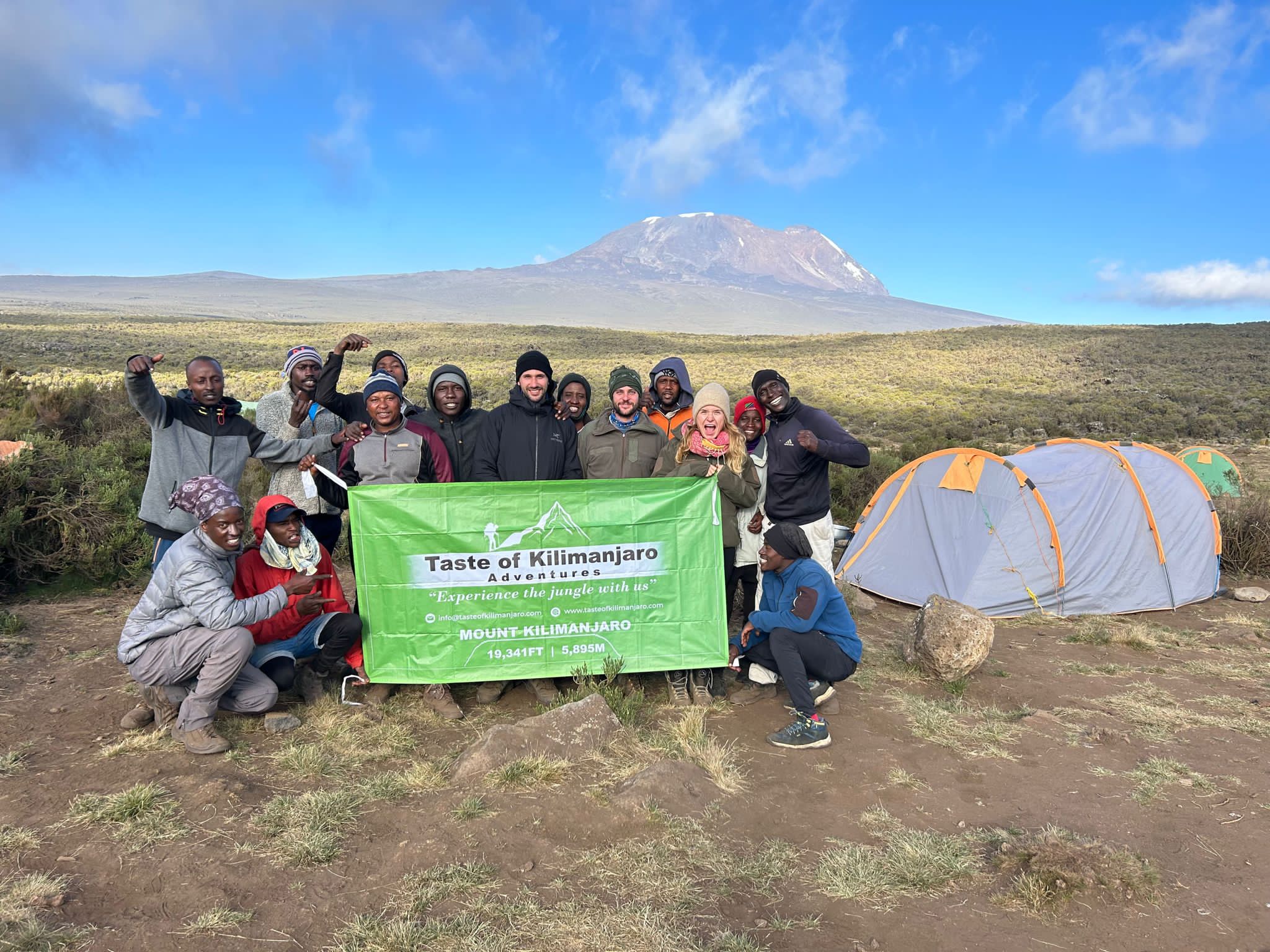
8-Day Mount Kilimanjaro Climb Via Lemosho Route
Aghakhan Road
0/5
0% of guests recommend
Duration
1 Day
Tour Type
Guided Tour
Group Size
21 persons
Location
Kilimanjaro
Overview
TOUR OVERVIEW
The 8-day Mount Kilimanjaro climb via Lemosho Route is considered one of the most scenic trails on Mount Kilimanjaro, offering a high success rate due to its gradual ascent and good acclimatization profile. The journey begins on the western side of the mountain. It traverses through lush rainforests, the Shira Plateau, and the breathtaking Barranco Wall before summiting Uhuru Peak (5,895m). The 8-day Lemosho itinerary allows ample acclimatization, significantly reducing the risk of altitude sickness and increasing your chances of a successful summit. This route is not just about reaching the peak—it’s about enjoying the journey and experiencing the diverse landscapes.
TOUR HIGHLIGHTS:
þ Tour Name: 8-Day Lemosho Route Kilimanjaro Climb.
þ Duration: 8 Days / 7 Nights on the mountain
þ Total Distance: 70 km
þ Difficulty Level: Moderate to challenging
þ Success Rate: 90%-95%% (with proper acclimatization)
þ Scenery: Stunning landscapes, diverse ecosystems, and breathtaking views
þ Best Time to Climb: June – October & December – March
The eight-day option Mount Kilimanjaro climb via the Lemosho Route is highly recommended because:
1. Optimal Acclimatization: The 8-day itinerary provides ample time for acclimatization, which is crucial for successfully summiting Kilimanjaro. Spending more time at higher altitudes helps your body adjust to thin air, significantly lowering the risk of altitude sickness. Proper acclimatization is vital for a safe summit. |
2. Less Physically Demanding Per Day: The 8-day trek offers shorter daily hiking distances, making it less physically demanding than the 6-day Lemosho route. This makes the climb more manageable for those with less hiking experience or those seeking a more leisurely trek. |
3. Higher Success Rate: The 8-day route allows climbers to ascend gradually, providing more time for their bodies to adapt. This approach and extra rest days lead to a higher summit success rate and enhance the overall experience while safely reaching Uhuru Peak at 5,895 meters. |
4. More Time to Enjoy the Journey: The extended itinerary lets you fully immerse in the experience, appreciating the beauty of your surroundings and enjoying the transition through different mountain ecosystems. It's a more rewarding journey that fosters a deeper connection to the mountain. |
If you're looking for an adventurous climb that offers the ultimate Kilimanjaro experience with a higher success rate, the 8-day Lemosho Route is ideal. This route allows for the time and gradual ascent needed to fully appreciate the mountain while maximizing your chances of standing triumphantly at the summit of Mount Kilimanjaro.
A DETAILED ITINERARY FOR THE KILIMANJARO CLIMB - 8-DAY LEMOSHO ROUTE
Arrival in Tanzania.
Your adventure begins when we pick you up from Kilimanjaro International Airport and transfer you to your comfortable hotel in Moshi. Our Taste of Kilimanjaro Adventures expert guide will brief you on the 8-day Lemosho route trek, and conduct a gear check, and ensure you are well-prepared. Any Missing equipment? No worries—you can rent gear on this day.
Day 1: Lemosho Gate to Mti Mkubwa Camp
-Elevation: 2,100m to 2,790m
-Distance: 6 km
-Hiking Time: 3-4 hours
-Habitat: Rainforest
Your journey begins as we drive to Lemosho Gate (4 hours), where you will complete park entry formalities before heading to the Lemosho trailhead. From there, we embark on a scenic hike through the pristine rainforest, where you might spot colobus monkeys and exotic birds. We will reach Mti Mkubwa Camp for our first night under the African sky.
Accommodation: Mti Mkubwa Camp
Day 2: Mti Mkubwa Camp to Shira 1 Camp
-Elevation: 2,750m to 3,500m
-Distance: 8 km
-Hiking Time: 5-6 hours
-Habitat: Moorland
Leaving the rainforest behind, we ascend into a land of rolling hills, volcanic rock formations, and lush heather. Crossing the Shira Ridge, we are rewarded with breathtaking views of Kilimanjaro’s glaciers. A gentle descent leads us to Shira 1 Camp for the night.
Accommodation: Shira 1 Camp
Day 3: Shira 1 Camp to Shira 2 Camp
-Elevation: 3,500m to 3,840m
-Distance: 14 km
-Hiking Time: 5-7 hours
-Habitat: Moorland
We traverse the vast Shira Plateau, one of the highest plateaus on Earth. The landscape is otherworldly, with volcanic rock and alpine meadows stretching toward Kibo’s Glacier Peak. This is an excellent day for acclimatization as we make our way to Shira 2 Camp.
Accommodation: Shira 2 Camp
Day 4: Shira 2 to Lava Tower to Barranco Camp
-Elevation: 3,840m to 3,860m (via 4,600m)
-Distance: 7 km
-Hiking Time: 4-6 hours
-Habitat: Semi-Desert
Today is crucial for acclimatization! We ascend to the striking Lava Tower (4,600m), where we take a break before descending into the Barranco Valley. The landscape transforms as we navigate toward the spectacular Barranco Camp, known for its dramatic views.
Accommodation: Barranco Camp
Day 5: Barranco Camp to Karanga Camp
-Elevation: 3,860m to 4,200m
-Distance: 5 km
-Hiking Time: 4-5 hours
-Habitat: Alpine Desert
An exhilarating challenge awaits—the Barranco Wall! This steep but rewarding climb leads to Karanga Camp, where we rest for the evening. This shorter day is designed for acclimatization, ensuring you are prepared for the higher altitudes.
Accommodation: Karanga Camp
Day 6: Karanga Camp to Barafu Camp
-Elevation: 4,200m to 4,673m
-Distance: 4 km
-Hiking Time: 4-5 hours
-Habitat: Alpine Desert
We go to Barafu Camp, our base camp, for the summit push. From here, we admire stunning sunset views over Mawenzi and Kibo peaks. Early dinner and rest are essential—tomorrow is the big day!
Accommodation: Barafu Camp
Day 7: Barafu Camp to Uhuru Peak to Mweka Camp
-Elevation: 4,673m to 5,895m (Uhuru Peak) to 3,100m
-Distance: 5 km ascent / 12 km descent
-Hiking Time: 7-8 hours ascent / 4-6 hours descent
-Habitat: Arctic
Summit day begins at midnight! With headlamps illuminating the path, we trek through the starlit Arctic landscape, reaching Stella Point (5,756m) just in time for a breathtaking sunrise. The final push takes us to Uhuru Peak (5,895m)—the highest point in Africa!
After celebrating, we descend back to Mweka Camp for a well-earned rest.
Accommodation: Mweka Camp
Day 8: Mweka Camp to Mweka Gate to Moshi
-Elevation: 3,100m to 1,680m
-Distance: 10 km
-Hiking Time: 3-4 hours
-Habitat: Rainforest
A leisurely descent through lush rainforests takes us to Mweka Gate, where you receive your official summit certificate. This marks the end of your 8-day Kilimanjaro climb via the Lemosho route, and from here, we drive back to Moshi for a celebratory meal and a well-deserved rest.
Accommodation: Hotel in Moshi Town
Departure & Optional Safari
After an unforgettable Kilimanjaro experience, take time to relax before your flight. If you wish to continue exploring Tanzania, we offer safari extensions to Serengeti, Ngorongoro, and Zanzibar for the ultimate adventure!
Included/Excluded
Two nights’ accommodation in Moshi Town (Before & after the trek – B&B)
Airport pick up and drop off.
Qualified guides with mountain crew
Kilimanjaro National Park fees
All camping equipment: mountain tents, sleeping mats
Transport
Rescue fees
All meals on the mountain (breakfast, lunch, and dinner)
Guides and porters’ accommodations and their entry fees on the mountain
Pulse oximeter
First aid kit
Emergence oxygen
Katady filtered water through the trek
wages to guides and porters as approved by Kilimanjaro National Park Authority.
Flights – Domestic and international flights
Visa
Insurance
Tips to mountain crew
Personal Items
Personal Items
Laundry services (available at the hotel for an extra cost)
Itinerary
Travel Styles
Cultural
Nature & Adventure
Activities
FAQs
Which Kilimanjaro route is best?
Lemosho is considered the most beautiful route on Kilimanjaro and grants panoramic vistas on various sides of the mountain. It is the most favorite route because it offers a great balance of low traffic, scenic views, and a high summit success rate. Thus, the Lemosho comes highly recommended and is one of our client’s favorites.
Can I climb Kilimanjaro?
Sure, you can! Climbing Kilimanjaro does not require any technical skills or special equipment, just some physical fitness and determination, people from all walks of life can achieve a successful summited. Individuals from 7 to 89 years old have made it to the top. But the challenge should not be taken lightly. You do need to understand what lies ahead. Rest assured, you will find the answers to all your questions here.
How to avoid altitude sickness at the mountain?
Altitude sickness, also called Acute Mountain Sickness (AMS), is an illness caused by exposure to low air pressure; especially low partial pressure of oxygen, which many climbers experience at high altitudes.
There are several practical steps that you can take to minimize the chances of having to abandon your climb of Kilimanjaro due to the effects of altitude sickness:
• Acclimatize before the climb - This is easier said than done if you live at sea level but if you can spend time at high altitude before the actual Kilimanjaro climb then this is the very best way to avoid altitude sickness.
Starting the climb in the best possible health and with an excellent level of physical fitness is imperative. If you are fatigued, unwell, or stressed you are more likely to suffer from altitude seconds.
• Slow and steady - You need to keep your respiration rate low during the climb you should be able to maintain a normal conversation. If you are panting or breathing hard, you must slow down. Overworking your heart and lungs substantially increases your chance of becoming ill.
• Ascend slowly - Your guides will tell you “polepole polepole (slowly slowly) throughout your climb. Because it takes time to acclimatize, your ascension should be slow. You will make slow and steady progress each day to allow for a successful summit, what we want you to achieve.
• Climb high sleep low-Climbing to a higher altitude during the day and then sleeping lower allows for better acclimatization. Most routes comply with this principle and additional acclimatization hikes can be incorporated into your itinerary.
• Drink as much water as you can-Getting up in the middle of the cold night may be an unpleasant thought but altitude dehydrates you and the better you hydrate the quicker your body can acclimatize.
Even though you may not feel like it, you should eat as much as you possibly can at every meal. This will give you plenty of energy and help you to feel great. I find it also helps me to keep warm and sleep well at night, maybe with an extra layer of clothing.
• Sleep well. Sleeping well in a tent is an acquired skill. Spend a few nights out in a tent with a sleeping bag before your climb so that you are prepared for the routine, and that your body is accustomed to sleeping in a sleeping bag on a hard surface.
• Diamox is the prescription name for the generic drug acetazolamide. And, though acetazolamide is prescribed for the medical treatment of glaucoma, sleep apnea, epilepsy, and hypertension, it’s also used to prevent altitude sickness. You should consult with your doctor before taking it and let us know if you are planning on taking it during your climb.
• Relax-Relax and think positively. Although not pleasant, the vast majority of people suffer only mild altitude sickness. Do not think that every headache is cerebral edema and that every cough pulmonary edema as this is very unlikely. By relaxing and enjoying the climb you are far more likely to have a trouble-free experience.
• Daily health checks- Our guides are all experienced in identifying altitude sickness and dealing with the problems it causes with climbers. They are continuously watching you and speaking with you throughout the climb. Twice daily, in the morning and evening, our guides will contact health checks.
Who will be my guide?
Our knowledgeable and experienced guides have collectively mounted Kilimanjaro well over a thousand times. They are regularly trained in the latest guiding techniques, first aid, English language, zoological and geological topics, customer relations, and environmental conservation. They are fully licensed by the National Park authorities and most importantly they love their job.
What types of food and drinks will be provided during Kilimanjaro?
You will be amazed at the variety, quality & quantity of the food we serve you while you are on your Mount Kilimanjaro climb. As you are trekking for between 6-9 hours a day (before summit night) you will be burning a lot of calories – and as you are at a higher altitude – you are burning even more than at sea level.
• Ensuring that you are well-fed – and fully fueled for climbing Kilimanjaro is paramount – allowing you to have enough energy to get you to the top. On all of our Kilimanjaro climbs you will be fully supported by a team of professional chefs who will cater to every dietary requirement and who will provide you with 3 hot cooked meals a day – plus plenty of water and hot drinks. Every day you will be served different meals whilst on the mountain.
Snacks at camp – on arrival at camp there will be salty snacks & biscuits (we do recommend bringing some of your favorites from home though)
At each stop, there will be purified water, hot water for teas, coffee & hot chocolate!
• Dietary requirement - Remember to inform us if you have any special dietary requirements – Our chefs are also able to accommodate almost any dietary restrictions; vegan, vegetarian, gluten and lactose intolerant, and those with restrictions due to their religious beliefs.
Just let us know in advance of any dietary restrictions that you may have. If you have any questions or concerns about the food whilst on the climb, feel free to speak to our team and we can give you more information!
• Staying hydrated - Keeping hydrated is crucial in the Kilimanjaro acclimatizing process – and you will get dehydrated easily, not just from walking each day but by breathing in the air at higher altitudes. We ensure that there is always a plentiful supply of treated and filtered water in the camp each morning/ night and water will also be provided at lunch. Depending on your physiology you will need to take in between 3-4 liters of water each day. If you are not used to drinking this amount of water, many people find that adding electrolytes or flavored cordials helps to keep the taste buds excited. There will also be hot drinking water at the camp in eat morning/ evening as well as the lunch stop with a selection of teas, coffee, and hot chocolate.
Tour Location
Aghakhan Road
Reviews
0/5
Not Rated
Based on
0 review
Excellent
0
Very Good
0
Average
0
Poor
0
Terrible
0
No Review
Taste of Kilimanjaro Adventures

Member Since Nov 2025
from
$1,980.00
{{start_date_html}}
{{type.desc}}
{{type.display_price}} per person
Extra prices:
({{type.price_type}})
{{type.price_html}}
({{type.price_type}})
{{ type.price }}%
{{ formatMoney(type.price) }}
- {{total_price_html}}
- {{pay_now_price_html}}
You might also like
12%
from
$1,980.00